
Why E-Receipts Simplify Expense Reporting
E-receipts are transforming how businesses handle expense reporting by replacing traditional paper receipts with digital versions. Here's why they matter:
- Accuracy: E-receipts reduce errors by using technologies like OCR and AI to pull transaction details directly, eliminating manual entry mistakes.
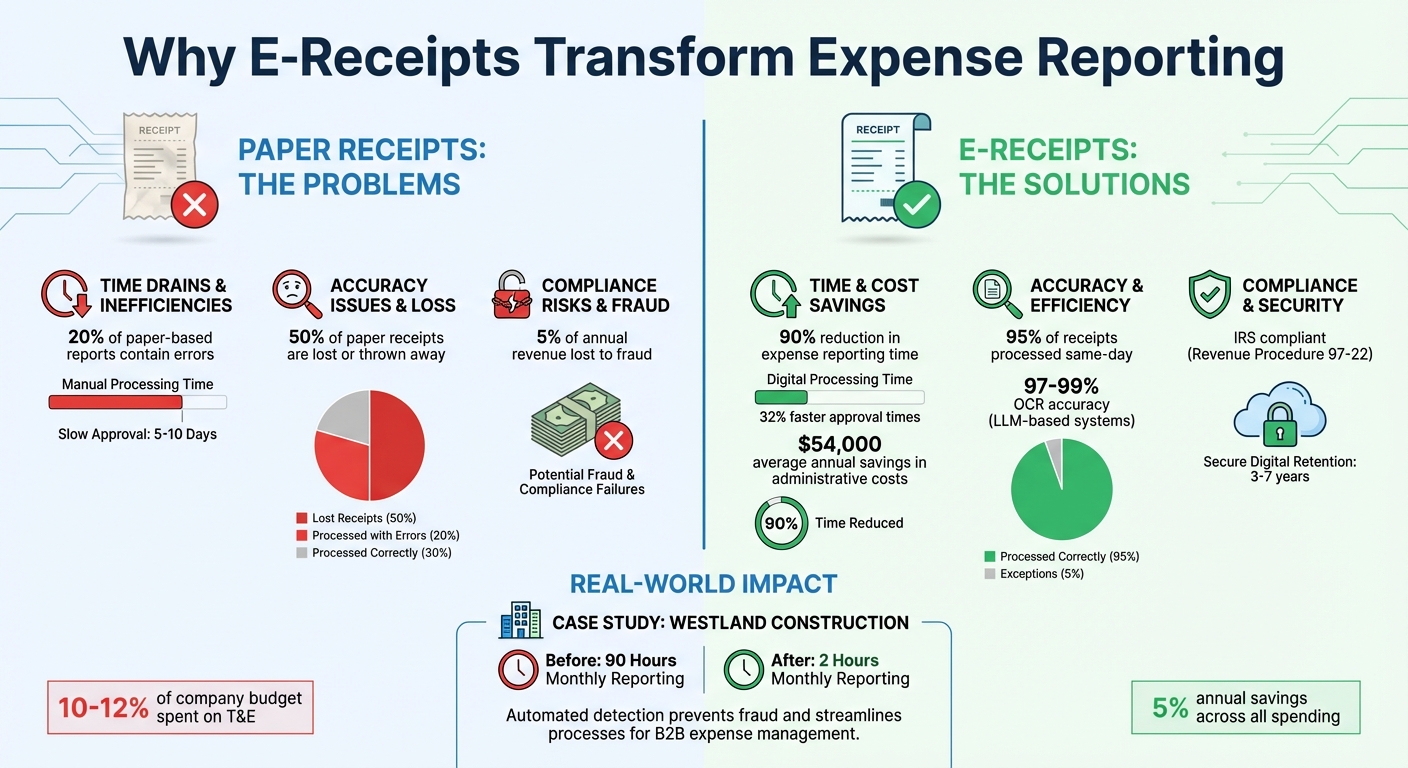
- Time Savings: Automated systems can cut expense reporting time by up to 90%, saving businesses an average of $54,000 annually.
- Convenience: Digital receipts are easy to store, search, and access, solving issues like lost or damaged paper receipts.
- Compliance: E-receipts meet IRS standards, creating clear, searchable audit trails for tax purposes.
- Efficiency: Tools like EasyTripExpenses simplify the process further by automating receipt uploads, categorization, and report generation.
Switching to e-receipts not only saves time and money but also streamlines operations, making expense reporting faster and more reliable.
E-Receipts vs Paper Receipts: Key Benefits and Cost Savings
What Are E-Receipts?
E-Receipt Basics
An e-receipt (short for electronic receipt) is a digital version of the traditional paper receipt, providing proof of purchase in formats like PDF, JPG, or PNG. These receipts include all the usual details - vendor name, transaction date, purchased items, prices, and taxes - just in a digital format.
E-receipts are created at the point of sale (POS) or through e-commerce platforms. Instead of being printed on paper, the transaction data is compiled and sent digitally, often via email, text message, or an app. If your payment method is linked, the receipt delivery can even happen automatically.
One of the biggest advantages? E-receipts are stored digitally, so they don’t fade, tear, or get lost like paper receipts. They can be saved in the cloud, on a hard drive, or within financial software, making them easy to search and access from anywhere. Plus, they’re legally valid for tax filings and audits.
How E-Receipts Work in Expense Reporting
E-receipts also play a key role in simplifying expense reporting. Many modern systems use technologies like Optical Character Recognition (OCR) and AI to pull important details - such as the merchant, date, and amount - directly from the receipt, cutting down on manual data entry.
For instance, when purchases are made using a linked corporate card or through vendors like Uber, Delta, or hotel chains, the receipt can be sent straight to your expense management software. These systems then match the receipt with the corresponding transaction and automatically fill out expense reports, making the reimbursement process faster and easier.
Take the example of Westland Construction: In 2024, their Accounts Payable Manager, James Streeter, shared how automated receipt capture reduced monthly expense reporting time from 90 hours to just 2 hours. Employees simply snapped photos of receipts using a mobile app, which synced directly with the company’s accounting software.
This kind of integration also solves the "shoebox problem", where nearly half of all paper receipts are lost or thrown away before they can be recorded. On top of that, e-receipts create a searchable, organized audit trail, making compliance checks and tax audits much smoother.
sbb-itb-386cb5b
Benefits of E-Receipts for Expense Reporting
Fewer Errors and Better Accuracy
Manual data entry often leads to mistakes. Employees typing in merchant names, dates, or amounts are bound to make errors - whether it’s a typo or a misread receipt. E-receipts solve this problem by using OCR (Optical Character Recognition) and AI to pull transaction details directly from digital sources.
Today’s platforms can process and match 95% of receipts on the same day the transaction clears. When vendors like airlines, hotels, or rental car companies send receipts directly to these systems, the accuracy improves even further, as the information comes straight from the source. Predefined rules also help by automatically categorizing expenses, cutting approval times by 32%. This means finance teams spend less time fixing errors or chasing clarifications, allowing for faster and smoother processing.
Time Savings and Faster Processing
E-receipts don’t just improve accuracy - they also save time. Think about how much time is wasted sorting through piles of paper receipts at the end of the month. With e-receipts, employees can snap a photo or forward an email right after making a purchase, eliminating the need to collect and organize physical receipts.
This shift to automated expense management can save companies an average of $54,000 annually in administrative costs. By automating repetitive tasks like data entry and reconciliation, finance teams can focus on higher-level analysis, while employees enjoy quicker reimbursements thanks to automated approval workflows.
Easy Access and Storage
Paper receipts are notorious for fading, tearing, or simply disappearing. E-receipts stored in the cloud eliminate these issues, providing a permanent, searchable archive that’s accessible from anywhere. Searching for a specific expense? A quick keyword search by vendor, date, or category replaces hours of digging through filing cabinets.
This accessibility is especially helpful during audits or tax season. Digital records create clear audit trails, making it easy for finance teams and auditors to verify transactions. Plus, the IRS accepts e-receipts as long as they are clear, legible, and easy to retrieve. Cloud storage also protects records from disasters - whether it’s a flood or an office move, your data stays secure and accessible for teams, no matter where they are.
Key Features of E-Receipts
Automatic Categorization with OCR Technology
E-receipts leverage Optical Character Recognition (OCR) to pull transaction details and organize them into business expense categories. There are three types of OCR systems: traditional (with 64% accuracy), AI-enhanced (85-95%), and LLM-based, which achieves an impressive 97-99% accuracy.
This technology captures essential data like the merchant’s name, transaction date, and amount. Machine learning further refines this process by adapting to different receipt formats, minimizing the need for manual corrections. Pre-processing steps - such as adjusting image orientation and improving contrast - make even low-quality images usable. The result? Less manual effort and fewer errors in your expense reports.
Once categorized, the data flows seamlessly into your accounting systems, ensuring smooth and accurate entries.
Integration with Accounting Systems
E-receipts directly integrate with accounting platforms through Application Programming Interfaces (APIs), automating the syncing of transactions and reports. This eliminates repetitive manual tasks and speeds up expense submissions. For example, when paired with tools like QuickBooks, receipts can be synced in three ways: stored as an attachment, linked to a new expense transaction, or broken down into itemized details. Real-time matching aligns receipt data with transactions, removing the need for reconciliation.
This two-way synchronization means any updates in your expense management tool are instantly reflected in your accounting software. For businesses handling complex receipts - like hotel bills with multiple charges - itemized syncing ensures each cost (room charges, taxes, parking) is accurately accounted for. This streamlined data flow keeps your records precise while eliminating the hassle of double-entry.
Such integration also strengthens compliance and audit readiness, discussed below.
Easier Compliance and Auditing
E-receipts are recognized by the IRS under Revenue Procedure 97-22 and Publication 552, granting them the same validity as paper receipts. To stay compliant, digital receipts must clearly display details such as the payee’s name, amount paid, proof of payment, transaction date, and a description of the purchase. The IRS mandates businesses to retain these records for at least three years after filing, though certain circumstances may require up to seven years.
"Electronic information management has become the standard in the private sector, and obtaining accounting records in electronic format provides significant advantages." - IRS
Digital storage systems create searchable audit trails by employee, merchant, or date, making audits faster and more efficient. AI tools can automatically detect duplicates, mismatched entries, and policy violations, which is crucial given that companies lose up to 5% of annual revenue to fraud, with travel and expense fraud being a major contributor. These advanced auditing features not only save time but also enhance security. Additionally, cloud-based storage ensures your records are protected from physical damage, keeping them accessible and secure for compliance purposes.
Cost Savings and Efficiency Gains
Lower Administrative Costs
E-receipts don't just save time - they save money too. Automated expense management systems, powered by OCR and AI technologies, handle the tedious task of extracting transaction details, eliminating the need for manual data entry. Say goodbye to filing cabinets, archive boxes, and office space dedicated to storing paper records for the IRS-required six-year retention period. With instant cloud capture, digital receipts simplify expense reporting and solve the problem of lost documentation, sparing employees the hassle of reconstructing expense reports from memory.
Automation brings even more perks: approval times are slashed by 32%, allowing managers and finance teams to concentrate on strategic goals. Fraud detection systems flag duplicate submissions and policy violations before they’re processed, addressing the 5% of annual revenue that companies typically lose to expense fraud. On top of that, organizations using modern finance platforms report saving an average of 5% annually across all spending. These combined savings not only reduce costs but also pave the way for better control and transparency in managing expenses.
Better Visibility into Expenses
E-receipts don’t just cut costs - they make tracking expenses easier and more transparent. By turning expense management into a real-time process, they provide instant oversight. Centralized dashboards let finance teams see company spending at a glance, flagging out-of-policy transactions as they happen. This immediate access allows for quicker budget adjustments and helps identify trends across vendors, employees, or spending categories.
"Ramp gives us one structured intake, one set of guardrails, and clean data end-to-end - that's how we save 20 hours/month and buy back days at close." - David Eckstein, CFO, Vanta
This level of real-time visibility is especially useful for travel and expense (T&E) spending, which typically eats up 10-12% of a company’s annual budget. With daily monitoring, finance teams can negotiate discounts with frequently used suppliers and make smarter decisions about resource allocation. By transforming historical expense data into a tool for future planning, e-receipts enhance operational efficiency while complementing the reduced administrative workload. It’s a win-win for financial oversight and productivity.
How to track business expenses with automation & AI
How EasyTripExpenses Simplifies E-Receipt Management
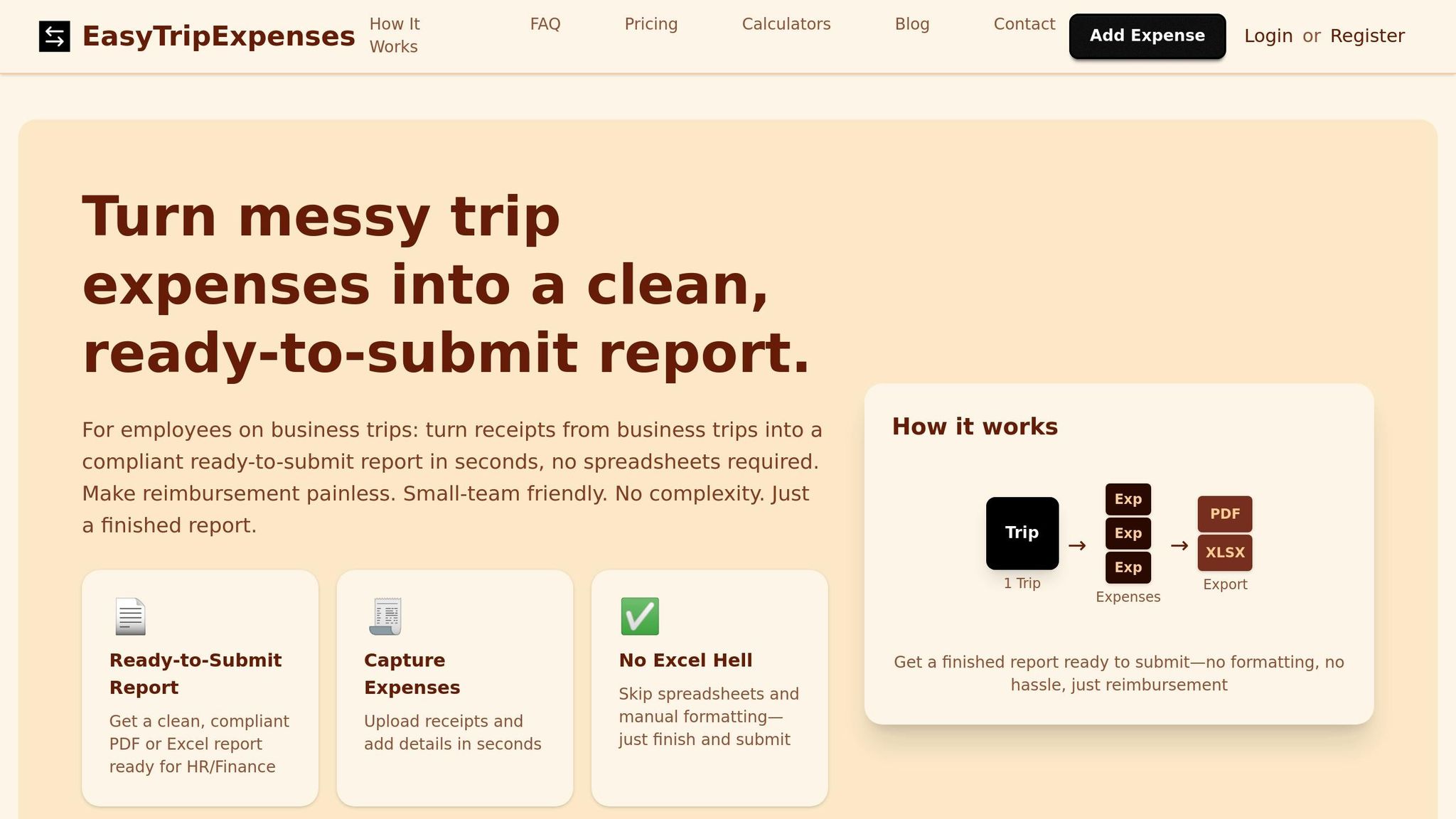
For small businesses, startups, and agencies juggling business travel, EasyTripExpenses offers a simple solution for managing e-receipts - no need for complicated enterprise software. The platform turns scattered expenses into polished, ready-to-submit reports. Users can upload receipts, organize expenses, and generate professional documentation - all without needing IT support or training. By focusing on simplicity, EasyTripExpenses ensures every step of the process is straightforward, from uploading receipts to creating reports and keeping your data secure.
Uploading and Categorizing Receipts
Uploading receipts with EasyTripExpenses is a breeze. Whether it’s snapping a photo of a paper receipt or forwarding digital copies from your email, users can upload images or PDFs directly through the platform’s web interface. It supports multiple file formats, so you can capture everything from meal receipts to hotel invoices as they come in.
Once uploaded, expenses can be categorized manually to align with your company’s accounting needs - like meals, travel, lodging, or client entertainment. Users also have the option to add comments to each entry, offering extra context for managers or accountants. This added detail not only reduces errors but also makes audits or credit card reconciliations much smoother.
Creating Reports for Submission
Once expenses are categorized, compiling them into formal reports is just as simple. With a single click, EasyTripExpenses generates PDF or Excel reports, ready for submission. For international expenses, the platform automatically handles multi-currency reporting, saving users from manual calculations and ensuring all submissions are consistent. This eliminates the hassle of formatting spreadsheets or assembling bulky paper reports.
Secure Storage and Access
Receipts uploaded to EasyTripExpenses are stored securely in the cloud, with retention periods based on your subscription plan. The free Starter plan keeps records for one year, while the annual Pro plan retains them for five years. This storage system meets IRS requirements, which typically call for businesses to keep expense documentation for six years, removing the need for physical filing. Users can access their expense history anytime, making tax preparation or compliance audits far less stressful - no more digging through emails or desk drawers for old receipts.
Conclusion
E-receipts have reshaped how businesses manage expense reporting. By automating data capture, they minimize expense report errors - impacting nearly 20% of paper-based reports - and reduce expense approval times by up to 32%. Companies that transition to digital expense management can save an average of $54,000 annually on administrative costs while benefiting from instantly searchable, IRS-compliant records.
But the benefits go beyond just efficiency. E-receipts bolster fraud prevention, support sustainability efforts, and safeguard records during emergencies. Automated systems can quickly detect non-compliant spending, while cloud storage ensures financial records stay secure, even during office relocations or unforeseen disasters. Unlike paper receipts, digital documentation eliminates the risk of losing critical records.
Digital platforms take these advantages even further. For small teams and startups juggling business travel, platforms like EasyTripExpenses simplify e-receipt management. From uploading and categorizing receipts to generating professional reports with automatic currency conversion, the platform streamlines the entire process. Plus, its secure cloud storage retains records for up to five years on the Pro plan, meeting compliance requirements without the need for physical filing systems.
This enhanced approach to expense reporting not only protects revenue - addressing the estimated 5% lost to fraud and the 10–12% spent on travel and expenses - but also provides real-time spending transparency. The result? Faster reimbursements, cleaner financial records, and less time spent on manual tasks.
Switching to e-receipts is a smart move for businesses looking to improve accuracy, cut costs, and simplify operations. With tools like EasyTripExpenses, the transition becomes effortless, transforming a tedious chore into an efficient, automated process.
FAQs
Are e-receipts accepted by the IRS?
Yes, the IRS accepts digital receipts, including scanned or electronic copies, as valid proof for tax purposes. To be acceptable, these receipts must meet certain IRS standards: they need to be clear, easy to read, and include essential details like the date, amount, and vendor information.
How do I keep e-receipts audit-ready?
To ensure your e-receipts are ready for audits, it’s crucial to organize and store them securely in a consistent system. Start by digitizing your receipts, then sort them by date, vendor, and expense type. Regularly backing up these files is also essential. Tools like EasyTripExpenses can streamline this process by letting you upload, organize, and generate reports - all within a single, secure platform. Keeping receipts well-organized not only ensures compliance with tax and legal requirements but also makes them easy to access when needed for audits.
How can EasyTripExpenses speed up expense reports?
EasyTripExpenses takes the hassle out of expense reporting by automating tedious tasks like manual data entry and categorization. With its AI-powered OCR technology, users can simply upload receipts - whether through a photo or email - and the system extracts all the important details, minimizing errors. Expenses are then automatically sorted into categories, making reviews a breeze. Plus, it allows users to generate polished reports in PDF or Excel formats for quick submission. This entire process helps streamline workflows, saving both time and effort on administrative tasks.