

Multi-Currency Reporting: Challenges and Fixes
Multi-currency reporting is essential for businesses operating globally, but it comes with its own set of challenges. Fluctuating exchange rates, compliance with accounting standards like US GAAP and IFRS, and the complexity of consolidating financial data from multiple currencies can distort financial performance, disrupt operations, and lead to errors. manual processes, such as using spreadsheets or inefficient small business expense tracking solutions, only add to the risks by increasing the chances of mistakes and slowing down reporting.
Key Challenges:
- Exchange Rate Volatility: Impacts transaction timing and financial consolidation, creating risks like paper gains or losses.
- Data Integration Issues: Consolidating financial data from subsidiaries with different currencies is time-consuming and prone to errors.
- Compliance with Standards: Adhering to guidelines like IAS 21 requires careful handling of exchange rates and adjustments for hyperinflationary economies.
- Manual Errors: Spreadsheets and manual processes lead to inefficiencies and inaccuracies.
Solutions:
- Automation: Modern ERP systems automate currency conversions and financial consolidations, reducing errors and saving time.
- Centralized Data Management: Shared accounting systems provide real-time data consistency and streamline operations.
- Standardized Practices: Uniform policies for exchange rates and reporting ensure clarity and simplify compliance.
Tools like EasyTripExpenses simplify multi-currency expense reporting by automating currency conversions, generating reports quickly, and securely storing data. These solutions help businesses manage global financial operations effectively, ensuring accuracy and compliance while reducing manual effort.
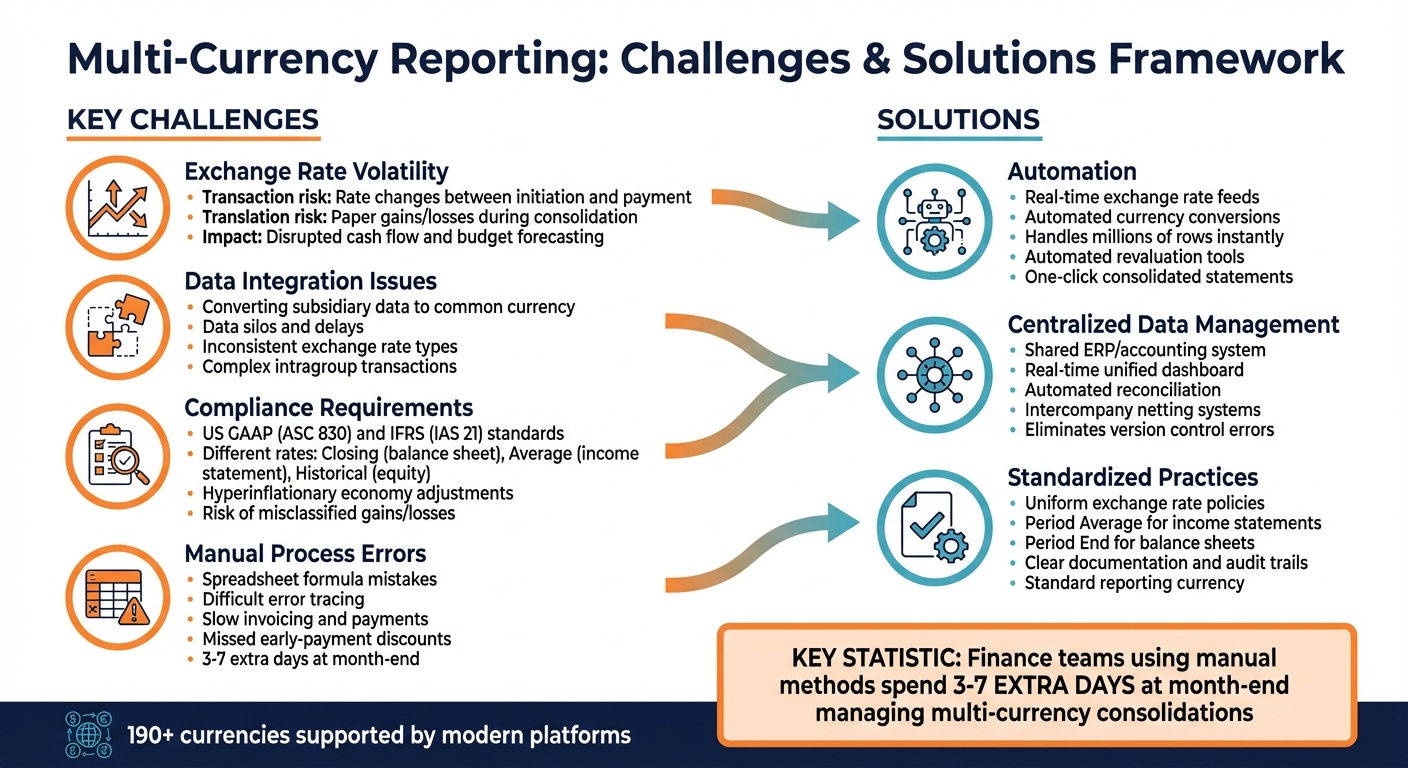
Multi-Currency Reporting Challenges and Solutions Framework
How does multi-currency support help businesses manage global transactions?
sbb-itb-386cb5b
Key Challenges in Multi-Currency Reporting
Handling finances across multiple currencies presents a range of challenges that can disrupt both day-to-day operations and long-term planning.
Exchange Rate Fluctuations
Currency values don’t stay still, and this volatility introduces two main risks. First, there’s transaction risk, which occurs when exchange rates change between the time a transaction is initiated and when payment is completed. Then there’s translation risk, which impacts financial consolidation, causing paper gains or losses when translating foreign financial statements into a single reporting currency.
These fluctuations can throw off cash flow, making it harder to plan budgets or forecast financial outcomes effectively.
Data Integration and Consolidation Problems
Merging financial data from subsidiaries operating in different currencies is no small feat. Before consolidating results, each entity’s data must be converted into a common reporting currency. This process often creates data silos and delays, especially when dealing with intricate intragroup transactions.
Relying on manual processes or spreadsheets only adds to the chaos. Human errors, such as inconsistent use of exchange rate types, can creep in and distort the data. The complexity of these tasks underscores the importance of tools that can integrate data seamlessly and handle currency conversions accurately.
Meeting Accounting Standards Requirements
For global businesses, adhering to accounting standards like US GAAP (ASC 830) and IFRS (IAS 21) adds another layer of complexity. As PwC explains:
"Globalization has led to increased complexities with respect to the application of this guidance."
One major challenge under IAS 21 is deciding which exchange rates to use and how to reflect exchange rate changes in financial statements. For example, balance sheet items typically require closing rates, income statement items use average rates, and equity accounts often rely on historical rates.
Hyperinflationary economies add yet another wrinkle. Financial statements from these regions must first be restated under specific standards before translation. Missteps, like misclassifying foreign-currency gains or losses, can distort earnings and lead to compliance issues.
Problems with Manual Processes
Manual methods, like using spreadsheets for currency conversions, are a breeding ground for errors. A single mistake in applying exchange rates or setting up conversion formulas can snowball across large transaction volumes, making it nearly impossible to trace and correct. This is especially problematic when reconciling bank accounts that involve multiple currencies, varying transaction dates, and fluctuating rates.
Manual processes also slow down critical tasks like invoicing, supplier payments, and month-end closings. This can damage vendor relationships and even cause businesses to miss out on early-payment discounts. Worse, manual systems might fail to flag when an economy becomes "highly inflationary", a situation requiring immediate adjustments in accounting methods.
To tackle these challenges, businesses need automated, centralized, and standardized systems - solutions that will be explored in the next section.
Solutions to Multi-Currency Reporting Challenges
Modern tools and processes have made tackling multi-currency reporting challenges far more manageable.
Using Technology for Automation
Automation takes the guesswork out of multi-currency reporting by reducing manual effort and eliminating spreadsheet errors and simplifying expense reporting. With real-time data feeds, exchange rates are always current, ensuring accurate calculations. Advanced ERP systems can handle massive data volumes and perform real-time currency conversions seamlessly. These systems can instantly clean, transform, and summarize millions of rows of data, freeing up finance teams to focus on meaningful analysis instead of tedious data compilation.
Automated revaluation tools adjust asset and liability accounts to reflect changes in exchange rates. Some platforms even allow users to generate consolidated financial statements across multiple global subsidiaries with a single click. This shift lets finance teams prioritize strategic insights over manual reporting tasks.
Building on automation, centralized data systems ensure consistency and eliminate data silos, further streamlining operations.
Centralized Financial Data Management
Centralizing financial data is key to creating a unified and reliable foundation for reporting. When all subsidiaries operate within a shared accounting or ERP system, everyone works with the same up-to-date information, eliminating issues like data silos and version control errors.
These centralized systems consolidate data from multiple currencies into a single, real-time dashboard, simplifying both reconciliation and consolidation. Automated reconciliation tools can regularly check bank accounts, subsidiary ledgers, and intercompany transactions, flagging discrepancies early. Additionally, intercompany netting systems reduce the need for multiple cross-border payments, cutting down on conversion fees.
Once financial data is centralized and accurate, the next step is to ensure uniformity in accounting practices across the organization.
Standardizing Accounting Practices
While technology provides the tools, consistent accounting policies are essential for clarity and efficiency. Standardizing how exchange rates are applied - such as using a Period Average rate for income statements and a Period End rate for balance sheets - ensures consistency across the board. Clear documentation of currency-related decisions also helps avoid confusion and supports compliance efforts.
A standard reporting currency for consolidated financial statements offers stakeholders a clear and unified view of the business. Comprehensive documentation, including audit trails of currency transactions, hedging strategies, and applied exchange rates, simplifies audits and strengthens compliance. When everyone adheres to the same guidelines, monthly consolidations become a straightforward process instead of an ongoing challenge.
How EasyTripExpenses Simplifies Multi-Currency Expense Reporting
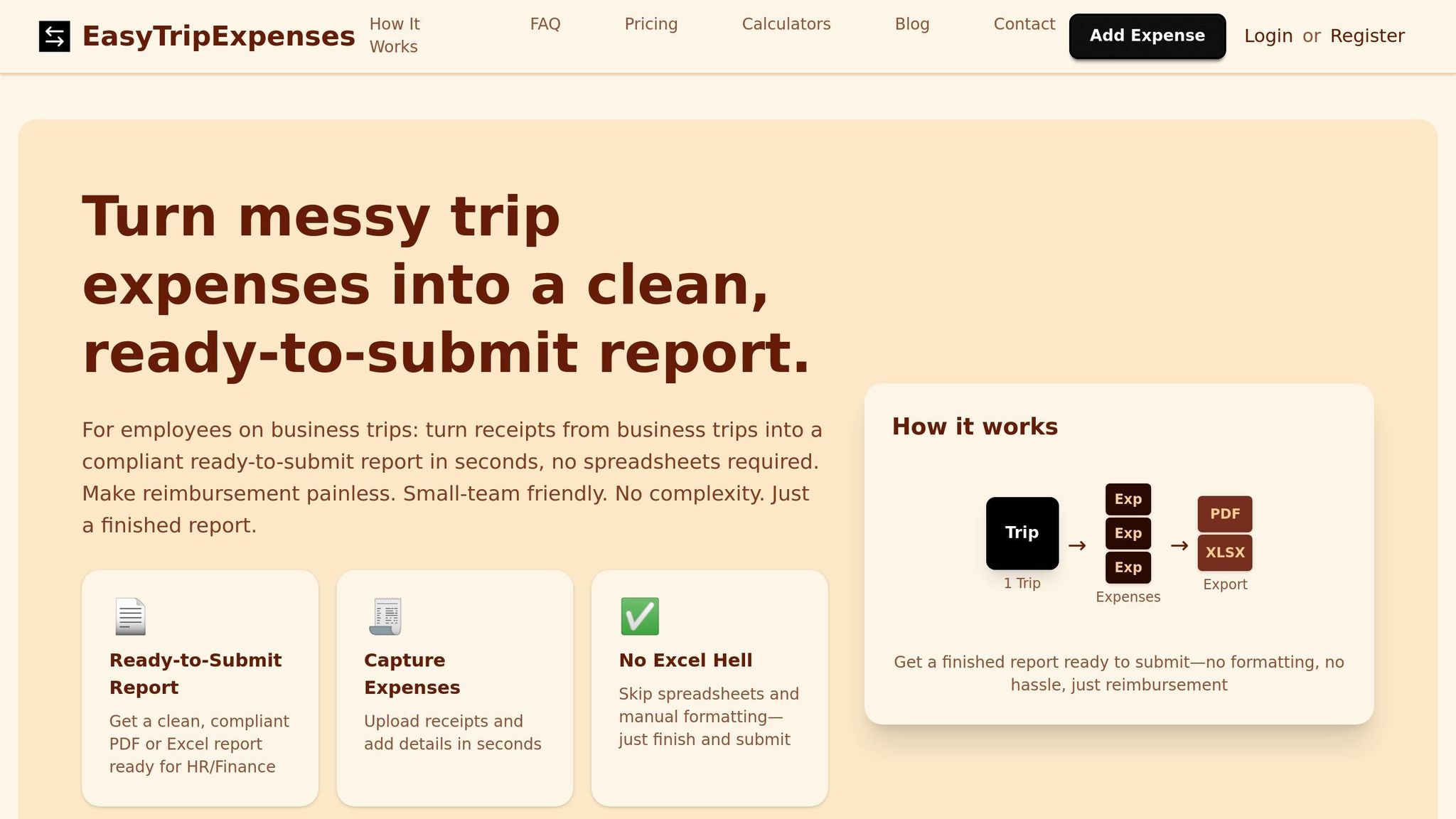
For small businesses, startups, and agencies juggling international travel expenses, handling costs across multiple currencies can be a headache. EasyTripExpenses takes the complexity out of the equation. By automating key processes, it simplifies multi-currency expense reporting without requiring intricate IT setups or extensive training. With this tool, managing currency conversions becomes effortless, as outlined below.
Automated Currency Conversion for Expense Reports
One of the standout features of EasyTripExpenses is its automated currency conversion. The platform converts foreign expenses into your home currency using up-to-date exchange rates. When you upload a receipt from an international trip, the system applies the correct daily exchange rate for the transaction date. For expenses that occur on weekends or non-trading days, it uses the most recent available rate. This automation not only eliminates common spreadsheet errors but also saves time. Finance teams relying on manual methods often spend an additional 3 to 7 days at month-end just to manage multi-currency consolidations. By simultaneously tracking both the original and reporting currencies, EasyTripExpenses reduces errors and speeds up the entire process.
Easy Report Generation
After uploading and categorizing expenses, the platform generates professional reports in seconds. These reports, available in both PDF and Excel formats, consolidate all multi-currency data seamlessly. Finance teams can also add detailed comments to individual expenses, making it easier to understand the context behind each transaction. Every currency conversion is backed by a clear audit trail, which is particularly helpful in volatile currency markets. For example, during the first four months of 2025, the US dollar lost nearly 10% of its value against the euro. Such transparency ensures accuracy and accountability in financial reporting.
Secure Data Storage and Trip History
EasyTripExpenses also excels in secure data storage. All expense data is stored in the cloud, with trip histories retained for 1, 3, or 5 years, depending on your plan. This makes it easy to reference past trips for audits, tax filings, or budget planning. Supporting over 190 currencies with automated updates, the platform ensures reliable and efficient multi-currency tracking, giving you peace of mind for both current and future financial needs.
Conclusion
Tackling the challenges of multi-currency reporting doesn’t have to drain resources or lead to costly mistakes. Issues like exchange rate volatility, manual processing risks, and complex compliance demands can pose serious threats to even the most skilled finance teams. As Chris Towner from FM Magazine aptly states, "The smaller the business, the more sensitive it can be to currency moves". Currency fluctuations can have a profound impact on financial outcomes, making effective management crucial.
The answer lies in automation and centralization. Relying on fragmented data and manual spreadsheets only increases the likelihood of errors. Specialized tools, on the other hand, minimize human mistakes and deliver real-time accuracy. By automating currency conversions, maintaining thorough audit trails, and standardizing reporting across all business units, companies can turn a labor-intensive process into a smooth, efficient operation.
Take international travel expenses as an example. Tools like EasyTripExpenses have revolutionized multi-currency expense reporting. With features like automated currency conversion for over 190 currencies, secure cloud storage, and quick professional report generation, EasyTripExpenses eliminates the usual pain points - all without requiring heavy IT investments or extensive training.
Adopting automated multi-currency solutions doesn’t just save time - it ensures accuracy, simplifies compliance, and positions businesses for long-term growth in today’s interconnected global market. These strategies align perfectly with the solutions outlined above.
FAQs
How does exchange rate volatility affect financial reporting?
Exchange rate fluctuations can have a noticeable impact on financial reporting, primarily through exchange differences that must be reflected in financial statements. When exchange rates change between the transaction date and the reporting date, monetary items often experience gains or losses. Additionally, translation adjustments for foreign operations are recorded in other comprehensive income. These shifts can make earnings seem more unpredictable, alter equity due to cumulative translation adjustments, and complicate cash flow forecasting.
To navigate these complexities, businesses need to frequently re-measure monetary assets and liabilities using the most current exchange rates. They must also translate foreign operation balances at closing rates. This can result in sizable adjustments on both balance sheets and income statements, potentially skewing trend analyses and key performance metrics. Leveraging tools that automate currency conversion and maintain consistent rates can simplify this process, minimize errors, and produce accurate, audit-ready financial reports.
What are the advantages of automating multi-currency reporting?
Automating multi-currency reporting can make a world of difference for businesses. With the help of software, tasks like exchange rate calculations and currency adjustments become seamless. This not only reduces the chances of manual errors but also ensures that rates are consistent and traceable. Plus, it helps businesses stay compliant with standards like U.S. SFAS #52 and IAS 21. The result? Financial reports that are more precise and a much clearer picture of your company’s financial standing.
Another big advantage is speed. Once a report is saved, the system locks in the relevant exchange rates. This means consolidations can be done quickly and accurately without the hassle of redoing calculations. It’s a time-saver that also minimizes risks, giving your team more room to focus on strategic decisions and better manage foreign exchange challenges.
For companies handling travel expenses, tools like EasyTripExpenses take automation a step further. They streamline the process by automating receipt uploads, handling currency conversions, and generating detailed multi-currency expense reports in just seconds. It’s a simple yet powerful way to keep expense management efficient and professional.
How can businesses comply with international accounting standards for multi-currency reporting?
To meet international accounting standards such as IFRS or U.S. GAAP, businesses need a consistent approach for managing multi-currency transactions. This involves determining the functional currency for each operation, accurately translating transactions and balances, and clearly disclosing the effects of exchange rate fluctuations.
Leveraging tools that automate currency conversion and reporting can make this process much easier. For instance, platforms like EasyTripExpenses simplify compliance by integrating currency conversion, receipt management, and professional report generation in formats like PDF or Excel. Staying compliant also requires keeping up with updates to accounting standards, documenting any changes to functional currencies, and ensuring staff are well-trained on the correct procedures to avoid costly mistakes.