

Why Reimbursement Timelines Matter for Small Teams
When employees cover business expenses out of pocket, delayed reimbursements can create financial stress, harm productivity, and damage trust within small teams. Employees often face interest charges, credit issues, and even avoid critical work activities due to these delays. For small businesses, the stakes are higher, as limited resources make errors, fraud, and IRS compliance risks more impactful.
Key Takeaways:
- Employee Impact: 38% feel stressed by delays; 78% say financial stress affects their work and personal life.
- IRS Compliance: Missing deadlines (e.g., the 60-day rule) can turn reimbursements into taxable wages, increasing tax burdens and paperwork.
- Small Team Challenges: Manual expense processes and errors waste time, with 1 in 5 reports containing mistakes.
- Solutions: Clear timelines, automation tools, and streamlined approval processes can reduce financial strain, improve morale, and simplify compliance.
Timely reimbursements aren’t just about finances - they build trust, improve retention, and keep operations running smoothly.
Simplify Employee Expense Reimbursements [Webinar]
IRS Guidelines on Reimbursement Timelines
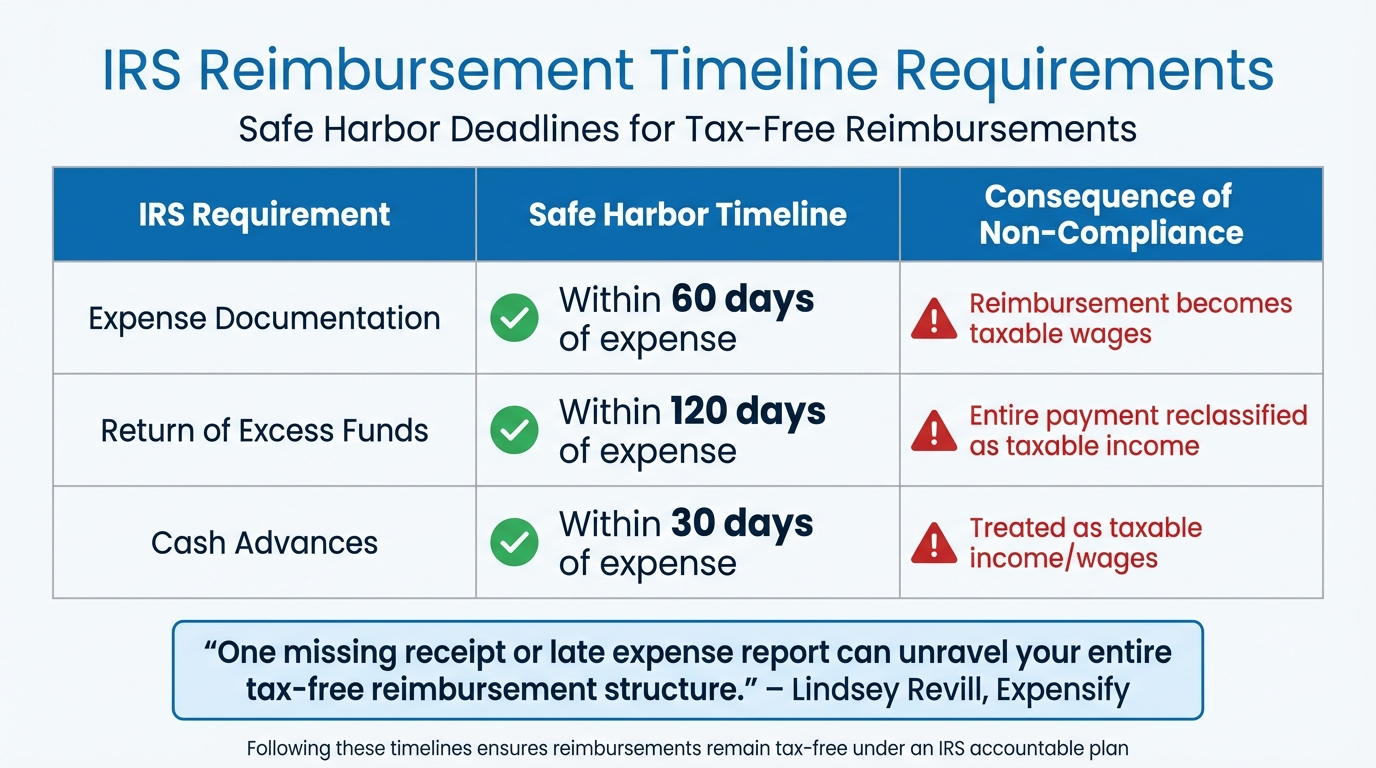
IRS Reimbursement Timeline Requirements and Compliance Consequences
The IRS has laid out clear rules about how and when employees should submit expense reports and return unused funds. These rules are designed to keep reimbursements tax-free. For small teams, understanding these guidelines is crucial - not just for staying compliant, but also to avoid payroll headaches and penalties. These timelines directly influence day-to-day financial and administrative tasks.
Key IRS Requirements
To ensure reimbursements stay tax-free, your company needs to follow what the IRS calls an "accountable plan." This means every expense must serve a legitimate business purpose, be properly documented within specific deadlines, and any excess funds must be returned promptly.
The IRS provides "safe harbor" timelines to guide these processes:
- The 60-day rule: Employees must submit receipts and documentation - detailing the amount, date, location, and business purpose - within 60 days of incurring the expense.
- The 120-day rule: If an employee receives funds exceeding their actual expenses, the extra amount must be returned within 120 days.
- The 30-day rule: For advances, any travel funds issued before a trip should be reconciled within 30 days of the expense being incurred.
"One missing receipt or late expense report can unravel your entire tax-free reimbursement structure." – Lindsey Revill, Expensify
Failing to meet these deadlines can have serious consequences. The IRS will classify the reimbursement under a "non-accountable plan", making it taxable. This means the payment will be subject to federal income tax withholding, Social Security, and Medicare (FICA) taxes, and the amount must be reported on the employee's W-2 form.
Here’s a quick overview of the IRS requirements and the risks of non-compliance:
| IRS Requirement | Safe Harbor Timeline | Consequence of Non-Compliance |
|---|---|---|
| Expense Documentation | Within 60 days of expense | Reimbursement becomes taxable wages |
| Return of Excess Funds | Within 120 days of expense | Entire payment reclassified as taxable income |
| Cash Advances | Within 30 days of expense | Treated as taxable income/wages |
Why IRS Guidelines Matter for Small Teams
For small teams, staying on top of these deadlines is critical. Missing them can lead to a domino effect of financial and operational problems.
First, when reimbursements become taxable wages, both the company and the employee face unexpected tax burdens. The company must retroactively withhold payroll taxes, and the employee loses the benefit of tax-free reimbursements.
Second, the administrative workload grows. Teams may need to update payroll records, recalculate taxes, and possibly file corrected W-2 forms. This creates unnecessary stress and uses up valuable time.
Finally, IRS audits become more complicated. The IRS can review records for up to three years after filing. Without proper documentation, defending your case during an audit becomes nearly impossible.
"Failing to meet the deadlines can convert an entire reimbursement into taxable income, not just the portion that was late." – AccountingInsights Team
The Business Case for Clear Reimbursement Timelines
Clear reimbursement timelines aren't just about checking off IRS boxes - they're a smart move for small teams. They directly influence your team's bottom line, keep operations running smoothly, and even boost workplace morale. For smaller teams juggling limited resources, these benefits can mean the difference between thriving and constant scrambling.
Better Cash Flow for Employees
When reimbursement timelines are clear, employees aren't left in the awkward position of essentially lending money to the company. Instead, they can manage their personal finances with more certainty. Predictable payback schedules ease financial stress and help employees plan ahead. This is especially vital for small teams, where salaries might be modest and financial buffers are thinner. It’s about giving employees the peace of mind they need to focus on their work, not their wallets.
Simpler Administrative Processes
Having clear timelines also makes life a lot easier for your administrative team. When expense submissions are predictable, you can avoid the chaos of employees dumping months of receipts all at once at the end of the reporting period. Instead, expenses can be processed in smaller, manageable batches.
Here’s why this matters: 62% of payment processing costs come from labor-intensive tasks like data entry, approvals, and reconciliation, according to Deloitte. By setting deadlines - say, requiring expense submissions within 30 days of purchase - you can keep financial records up-to-date and avoid bottlenecks.
| Process Aspect | Without Clear Timelines | With Clear Timelines |
|---|---|---|
| Submission Pattern | Irregular; end-of-period floods | Steady, predictable flow |
| Processing Time | Days or weeks | Hours or days |
| Error Rate | 19% of reports | Reduced through policy clarity |
| Administrative Cost | $58 per report | Lower with automation |
Streamlining these processes doesn’t just save money - it also shows employees you value their time and effort, which goes a long way in building trust.
Higher Employee Satisfaction and Retention
Delayed reimbursements can seriously harm employee morale. Nobody likes feeling like they're personally funding company operations. When financial stress builds up, it can lead to disengagement, lower productivity, and, ultimately, people leaving your team.
"Quiet quitting becomes real resignation, with your [employee's] valuable skills and connections now working for a competitor that reimburses their employees on time." - Jim Conroy, CEO, The Neat Company
For small teams, where every employee plays a crucial role, losing talent can be especially painful. Reliable reimbursement processes can actually give you an edge over bigger competitors. Paying employees back on time shows you respect their financial well-being, which builds trust and loyalty.
And here’s a telling stat: 76% of employees spend over 30 minutes each month compiling expense reports, and many say it’s their least favorite part of business travel. Simplifying this process is a small but powerful way to show your team you value their time and effort. It’s a gesture that can pay off in higher engagement and long-term retention.
sbb-itb-386cb5b
How to Create a Timeline-Focused Reimbursement Process
To build a reimbursement process that stays on schedule, focus on setting clear submission deadlines, defining documentation requirements, simplifying approvals, committing to fast payments, and having a plan for escalations. These steps align with IRS guidelines and help ensure a smooth and reliable system.
Set submission deadlines. It's generally recommended to require expense submissions within 30 days to stay in sync with payroll cycles. Whether your company processes payroll weekly, biweekly, or monthly, aligning deadlines with these cycles can prevent unnecessary delays and administrative headaches.
Specify required documentation. Each submission should include key details: the vendor’s name, purchase date, itemized costs, payment method, and the business purpose of the expense. Credit card statements alone won’t cut it - you’ll need itemized receipts for transparency. To make things easier, accept digital formats like photos, scans, e-receipts, or PDFs. You can also set a threshold, such as $25 or $75, where receipts are only required for larger expenses, while smaller ones just need a written explanation.
Streamline your approval workflow. Avoid bottlenecks by setting up tiered approval levels. For example, automatically approve expenses under $50, require manager approval for amounts between $50 and $500, and reserve executive sign-offs for anything over $5,000. Managers should aim to review submissions within 24–48 hours to keep things moving.
Commit to payment timelines. Once expenses are approved, aim to issue payments within 5–10 business days. Quick payments not only maintain financial stability but also build trust with employees.
"Ramp gives us one structured intake, one set of guardrails, and clean data end‑to‑end - that's how we save 20 hours/month and buy back days at close." – David Eckstein, CFO at Vanta
Create an escalation process. To handle issues like late submissions, missing documents, or disputes, establish a clear escalation protocol. For example, employees should return excess advances within 120 days to comply with IRS requirements for accountable plans.
| Process Step | Recommended Timeframe | Purpose |
|---|---|---|
| Employee Submission | 30–60 Days | Ensures IRS compliance and accurate month-end closing |
| Manager Approval | 24–48 Hours | Promotes timely decision-making |
| Company Payment | 5–10 Business Days | Builds trust and financial stability |
| Return of Excess Funds | 120 Days | Meets IRS requirements for accountable plans |
Using Technology to Simplify Reimbursement Timelines
How Technology Helps Expense Management
Timely reimbursements rely on quick and accurate processing, and advanced technology can make this process much smoother. Did you know that processing a single expense report manually costs about $58 and takes around 20 minutes?. Technology steps in to address these inefficiencies by automating key expense management tasks.
One of the biggest perks of automation is eliminating repetitive manual work. For instance, when employees snap a photo of a receipt, Optical Character Recognition (OCR) instantly extracts details like the vendor name, date, amount, and expense category - no typing needed. The system even auto-categorizes expenses based on merchant type or past patterns. So, if you grab coffee at a café, it’s automatically tagged as "meals."
Real-time policy enforcement is another game-changer. If your company caps meal expenses at $100, the software flags or blocks anything over that limit. Approval workflows are streamlined, with smaller expenses often auto-approved to keep things moving. Once approved, the expenses sync seamlessly with your accounting software, updating the general ledger without any extra effort.
This level of automation can cut processing time by up to 75%. In fact, in 2024, businesses using these tools saved an average of 4.2 hours per month. Beyond saving time, automation reduces errors and helps small teams maintain timely reimbursement processes.
"The best expense reporting experience you can have is to not have to do an expense report"
– David Barrett, Founder and CEO of Expensify
Benefits for Small Teams
For small teams, technology can be a lifeline, helping them tackle both financial and administrative challenges. Solutions like EasyTripExpenses are designed to work right out of the box - no IT setup required. It’s web-based, so employees can upload receipt images or PDFs, categorize expenses, add comments, and generate polished reports in PDF or Excel formats. Plus, it offers secure storage and built-in currency conversion.
Automated tools also make it easier to meet IRS reimbursement deadlines by ensuring all documentation is captured and submitted on time. These systems are scalable from the start. For example, a platform that works for a five-person team can easily handle fifty employees without requiring a complete overhaul. Additionally, the centralized audit trail keeps track of every transaction, approval, and receipt, simplifying tax season and compliance checks for small business owners.
With plans starting at just $5 per month (billed annually), small teams can enjoy up to 50 uploads per trip and five years of trip history. It’s an affordable way to grow without stretching your budget too thin.
Conclusion
For small teams, timely reimbursements are non-negotiable. Delayed payments force employees to shoulder business expenses on their personal credit cards, often leading to interest charges and late fees. This not only impacts their finances but also harms morale, potentially causing quiet quitting or even resignations.
Failing to substantiate expenses within 60 days can create serious challenges, especially for teams with limited resources. Clear reimbursement timelines protect both employee paychecks and your company’s tax compliance.
The good news? These issues are manageable with the right approach. By enforcing firm submission deadlines, automating approval processes, and using tools like EasyTripExpenses, you can simplify reimbursements without requiring a large HR team or complex IT setup. These tools make compliance and efficiency achievable, no matter your budget.
Timely reimbursements aren’t just a courtesy - they’re a responsibility. As Jim Conroy, CEO of The Neat Company, aptly says:
"Employees who lay out their own funds on behalf of your business deserve to be repaid straightaway... the business - and the risks and expenses - is yours and not theirs".
FAQs
What happens if IRS reimbursement deadlines are missed?
Missing IRS reimbursement deadlines can lead to serious complications. If deadlines aren't met, reimbursements might be classified as taxable wages, which could result in employees paying extra taxes. On top of that, employers could run into compliance problems, adding more stress to their operations.
For smaller teams, staying on top of these deadlines is even more critical. It helps avoid unexpected tax liabilities and keeps financial processes running smoothly.
What can small teams do to avoid delays in reimbursements?
Small teams can sidestep reimbursement delays by streamlining their expense management processes. One powerful way to do this is through automation. Automated tools minimize manual errors, speed up approvals, and improve overall accuracy. For instance, platforms like EasyTripExpenses let employees upload receipts, categorize their expenses, and quickly create detailed reports. This makes the reimbursement process faster and far less stressful for everyone involved.
Having clear policies in place is equally important. Establish firm deadlines for submitting expenses, and ensure these rules are communicated effectively to your team. This not only promotes accountability but also helps avoid unnecessary bottlenecks. By blending automation with well-defined guidelines, small teams can stay on top of reimbursements, boosting both team morale and financial efficiency.
Why is automating expense management essential for small teams?
Automating expense management is a game-changer for small teams. It streamlines the reimbursement process, cutting down on time and minimizing errors that often come with manual tasks. Think about it - managing expenses manually, like chasing down paper receipts and juggling approval processes, can lead to delays, mistakes, and extra administrative costs. Automation eliminates these headaches, ensuring faster reimbursements and greater accuracy. Plus, it keeps employees happy by reducing financial stress caused by delayed reimbursements.
On top of that, automated systems offer clear insights into spending patterns, help teams stay compliant with tax regulations, and lower the risk of fraud. With all expense data centralized, generating reports becomes a breeze, allowing teams to make faster, well-informed decisions. For small teams operating with limited resources, automation isn’t just a convenience - it’s a way to reclaim time for strategic priorities and drive growth while improving overall efficiency.